

Figaro VI 12 N 12
Designed by Johan Anker – Built by Anker & Jensen, 1936 (International Third Rule)
DESIGN AND CONSTRUCTION
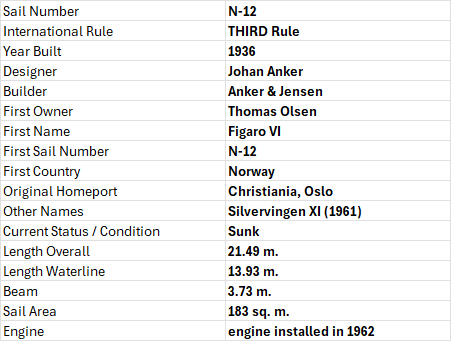
Figaro VI was designed by the Norwegian “master of lines” Johan Anker and launched from Anker & Jensen at Christiania (Oslo) in 1936 to the International Third Rule. Recorded principal dimensions for the class lists are LOA 21.49 m, LWL 13.93 m, Beam 3.73 m, with a sail area noted around 183 m². Built in wood to Anker & Jensen’s characteristic high standard, she joined the powerful Oslo 12-Metre fleet on the eve of the late-1930s Scandinavian heyday.
OWNERSHIP AND NAMES
1936–1960 – Thomas Olsen (Oslo). Campaigned as Figaro VI with Norwegian sail number 12 N 12.
1961–1962 – Nils Gäbel (Sweden). Renamed Silvervingen XI and based on the Stockholm archipelago scene (Saltsjö-Duvnäs).
1963–1965 – Nils Gäbel. Name reverted to Figaro VI.
1966 – Armand Goldmuntz (Brussels). Transferred to Belgium.
RACING AND LATER YEARS
Under Olsen, Figaro VI raced among the Norwegian 12s that frequented Oslofjord regattas and occasional international fixtures. By the early 1960s her move to Sweden placed her within the “Silvervingen” lineage familiar in that region’s classic-yacht circles. Like many Third-Rule Twelves of the period, she appears to have seen a mixture of club-level competition and cruising as ownership and venues changed.
FINAL DISPOSITION
The yacht disappears from the register in 1967 with contemporary notes indicating she sank that year. No evidence of subsequent salvage or restoration has surfaced, and she is generally regarded as lost.
LEGACY
Figaro VI represents the mature Norwegian interpretation of the Third Rule 12-Metre—long, fair overhangs and a well-balanced plan that typified Anker’s late work. Her trail from Oslo to Sweden and Belgium mirrors the broader migration of European Twelves after their front-line racing careers, and her loss in 1967 marks the end of a northern European chapter in the class’s history.