

Little Astra
Design & Construction
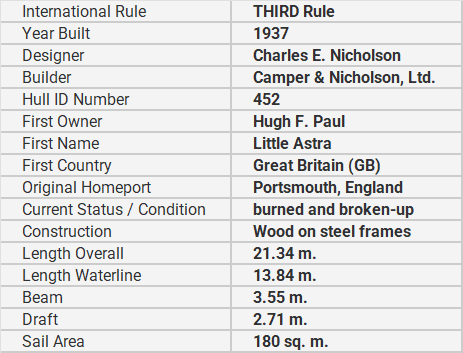
Little Astra was built to the International Third Rule and constructed of wood planking on steel frames, a common practice for late-1930s Twelve Metres seeking strength with reduced weight. She carried the sail number K-18 and was registered in Great Britain. The yacht was owned from new by Hugh F. Paul, who also owned the larger 23-Metre Astra, to which Little Astra later served as a tender.
Early Ownership and Racing Career (1937–1947)
From her launch in 1937, Little Astra was based in Portsmouth, Great Britain, sailing as a Bermudan-rigged sloop under Hugh F. Paul’s ownership. Despite active participation in seasonal racing, she was regarded as less successful than some contemporaries.
Her recorded racing results include:
1937: 5th overall out of 41 entries
3 firsts, 1 second, 9 thirds
1938: 4th overall out of 38 entries
2 firsts, 8 seconds, 5 thirds
During this period, Little Astra earned the reputation of being the “little sister” to the 23-Metre Astra, which later became a houseboat and tender to the Twelve.
Post-War Ownership Changes (1947–1952)
Following Hugh F. Paul’s death, ownership passed to the Estate of Hugh F. Paul in 1947. The yacht then changed hands several times:
1948: Owned by P. Hursell
1949–1951: Owned jointly by C. E. Gardner & P. Mursell
1952: Sole ownership by C. E. Gardner
Italian Ownership and Later Years (1952–1965)
In 1952, Little Astra was acquired by O.M.S.A. (Officine Meccaniche S.A.), with Genoa, Italy, listed as her home port. An engine was installed in 1952, reflecting her transition away from active Twelve Metre racing.
By 1965, the yacht disappeared from Lloyd’s Register, marking the end of her formal documentation within the class.
Final Disposition
By the late 1960s to early 1970s, Little Astra was laid up on behalf of Cantiere Valdettaro at Cantieri Ricciotti in Fezzano, La Spezia (Italy). She was ultimately broken up and burnt, bringing her history as an International 12 Metre to an end.
Summary
Little Astra represents a lesser-known but well-documented example of a Third Rule International 12 Metre—active in pre-war racing, closely associated with the notable Astra, and later absorbed into post-war industrial ownership before disappearing in Italy.