
Mouchette
Design & Construction
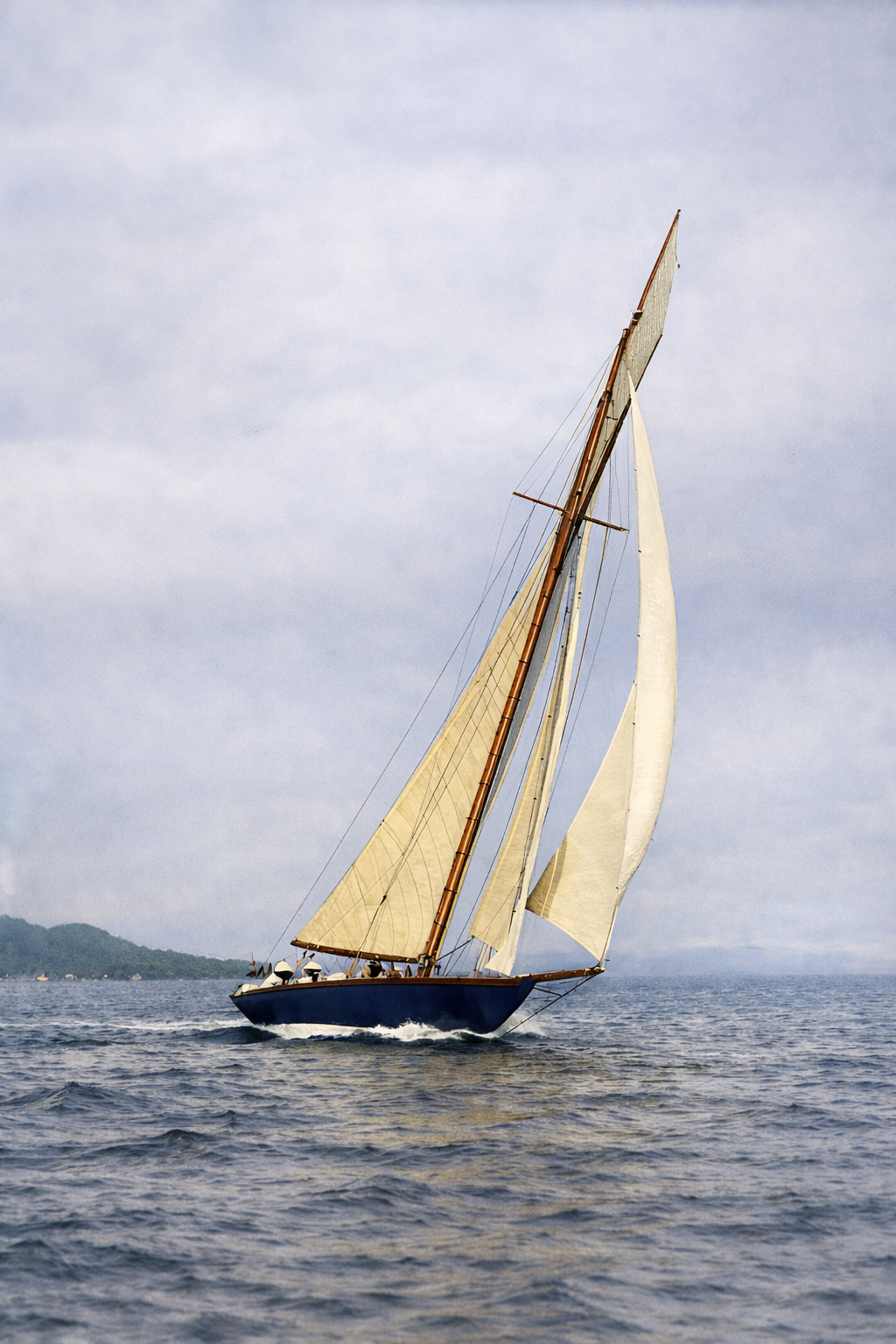
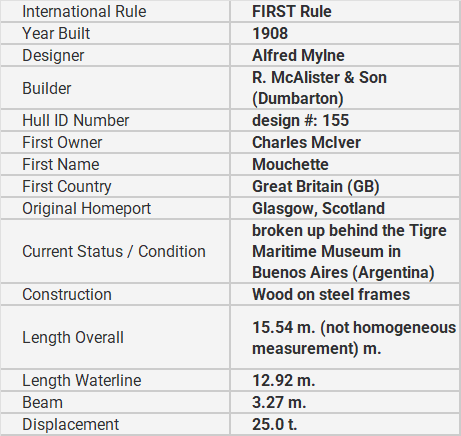
Mouchette was designed by Alfred Mylne (design no. 155) and built in 1908 by R. McAlister & Son at Dumbarton, Scotland, to the International First Rule. Her construction was notable for its speed—completed in only six weeks—and for her exceptionally light displacement. She was built with wood planking on steel frames and was the lightest of three Twelves constructed by McAlister at that time, the others being Hera and Nargie. Her original home port was Glasgow, Great Britain.
Early Ownership & Clyde Racing (1908–1909)
The original owner was Lord Charles McIver, head of the McIver Line, a shipping company operating routes between Great Britain and Argentina. The yacht was named Mouchette after a celebrated French thoroughbred of the period.
Mouchette achieved immediate success at Royal Western Yacht Club matches, benefiting initially from the absence of Alachie and Nargie. During this period, her keel was remodelled and rehung, the mast replaced with a lighter spar, and the mainsail changed, significantly improving performance.
1908 Olympic Games
Mouchette competed in the British trials for the 1908 Olympic Games and was selected alongside Hera to represent Great Britain. Olympic racing was held on the Clyde, rather than at Ryde, to avoid the long delivery sail. Both yachts were crewed by amateurs, a decision that sustained public interest despite the absence of foreign competition.
The Olympic course consisted of two laps of a 13-mile circuit. Hera won both races, but Mouchette pressed closely throughout. At the end of the first lap of the opening race, Hera led by only seconds, with both yachts executing over 30 short tacks on one leg. Hera ultimately prevailed, winning the second race by 62 seconds.
Lord Charles McIver, helmsman of Mouchette, was awarded the Olympic silver medal, along with J. G. Kenion (foreman) and the full amateur crew. McIver also received the commemorative Olympic trophy as owner.
Transfer to Argentina (1909–1915)
At the end of 1909, Mouchette was shipped to Argentina, reportedly facilitated by Celeste Fernández Blanco, and acquired by Alberto de Bary, Vice Commodore of the Yacht Club Argentino. Her home port became Buenos Aires.
In Argentine waters, Mouchette raced extensively against Alachie and Ráfaga, frequently prevailing over both in local regattas.
Subsequent Ownership in Argentina (1916–1935)
Ownership during this period included:
A. Séré & Juan J. Séré
Ing. Charles Lilloe, Fangen et Cie Polaczek
J. E. Wolden, under whom the yacht reappeared in Lloyd’s Register in 1923, noted as “formerly International Rating Class 12 Metres”
Harold Hauge
Carlos Hansen
These years reflect continued private ownership and intermittent registry documentation.
Later Years & Modifications (1936–1975)
After 1936, Mouchette again disappeared from Lloyd’s Register. An engine was installed in 1938, and by 1955 her rig had been altered to an auxiliary yawl. She was re-powered in 1957 under the ownership of Guillermo P. MacNally.
Final Status
According to later reports, including information attributed to Germán Frers Jr., Mouchette was still visible in the 1980s as a wreck behind the Tigre Maritime Museum near Buenos Aires. She was definitively broken up in the 1990s.
Her mast and gaff were preserved and today form part of the signal mast at the Yacht Club Argentino, San Fernando clubhouse, providing a tangible surviving link to one of the most historically significant early Twelves.