

Noresca 12 K 9
Design & Construction
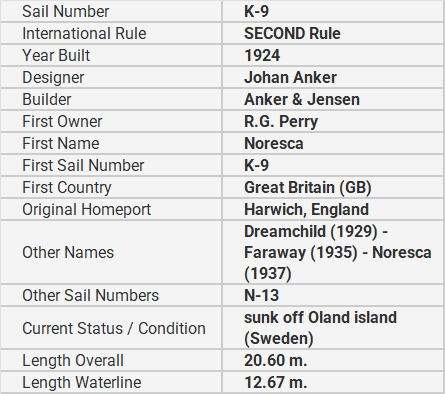
Noresca was built in 1924 to the International Second Rule. She is recorded as having been built for R. G. Perry and based at Harwich, Great Britain. Contemporary sources state that she was said to be the sister ship of Figaro IV, though this relationship is noted historically rather than formally documented.
Early British Ownership & Racing Success (1924–1929)
Owner: R. G. Perry
Name: Noresca
Home Port: Harwich, Great Britain
In 1925, Noresca enjoyed an exceptionally strong racing season, skippered by Captain Edward Heard, a professional sailor known for bold tactics and calculated risk-taking. That season she recorded:
17 firsts
3 seconds
4 thirds
She was subsequently owned by Sir William Burton, followed by F. G. Mitchell and R. Ellis Brown, remaining active in British waters through 1929.
Dreamchild & Return to Noresca (1929–1932)
Owner: J. R. Govett
New Name: Dreamchild (1929)
Under Govett’s ownership, the yacht was renamed Dreamchild in 1929, before reverting to the name Noresca in 1930. She continued racing during this period.
Auxiliary Conversion & Continental Ownership (1933–1936)
Owner: Corbett W. Woodall
Home Port: London, Great Britain
In 1933, an engine was installed, the sail area reduced, and the yacht was re-rigged as an auxiliary Bermudan cutter, marking a transition away from pure racing use.
She was subsequently acquired by R. S. Loewenstein, renamed Faraway, and based in Brussels, Belgium.
Scandinavian Period & Racing Revival (1936–1953)
Owner: Johan Anker
New Name: Noresca
Home Port: Asker, Norway
Sail Number: N-13
Under Anker’s ownership, the yacht reverted to her original name Noresca, and the engine was removed in 1934, restoring her closer to a racing configuration.
Ownership then passed to Th. Johnsen, based in Oslo, Norway.
In the late 1940s, Noresca took part in 12 Metre regattas organized by the Royal Norwegian Yacht Club (KNS), racing alongside Sanata, Diva, and Norsaga, representing a notable revival of Second Rule Twelve racing in Scandinavia.
Later Ownership & Loss (1954–1970)
After disappearing from Lloyd’s Register, the yacht was recorded under the ownership of Harald Bredo Eriksen, home port Oslo.
She was later sold to Sweden and is reported to have been sunk off the island of Öland, near Stockholm, between 1968 and 1970, bringing an end to her career.
Historical Significance
Noresca is notable for:
Her exceptional 1925 racing season
Multiple name changes reflecting changing roles
Transition from British racing yacht to Scandinavian Twelve Metre competitor
Participation in the post-war Norwegian Twelve Metre revival
A long and geographically diverse career ending in Scandinavian waters