
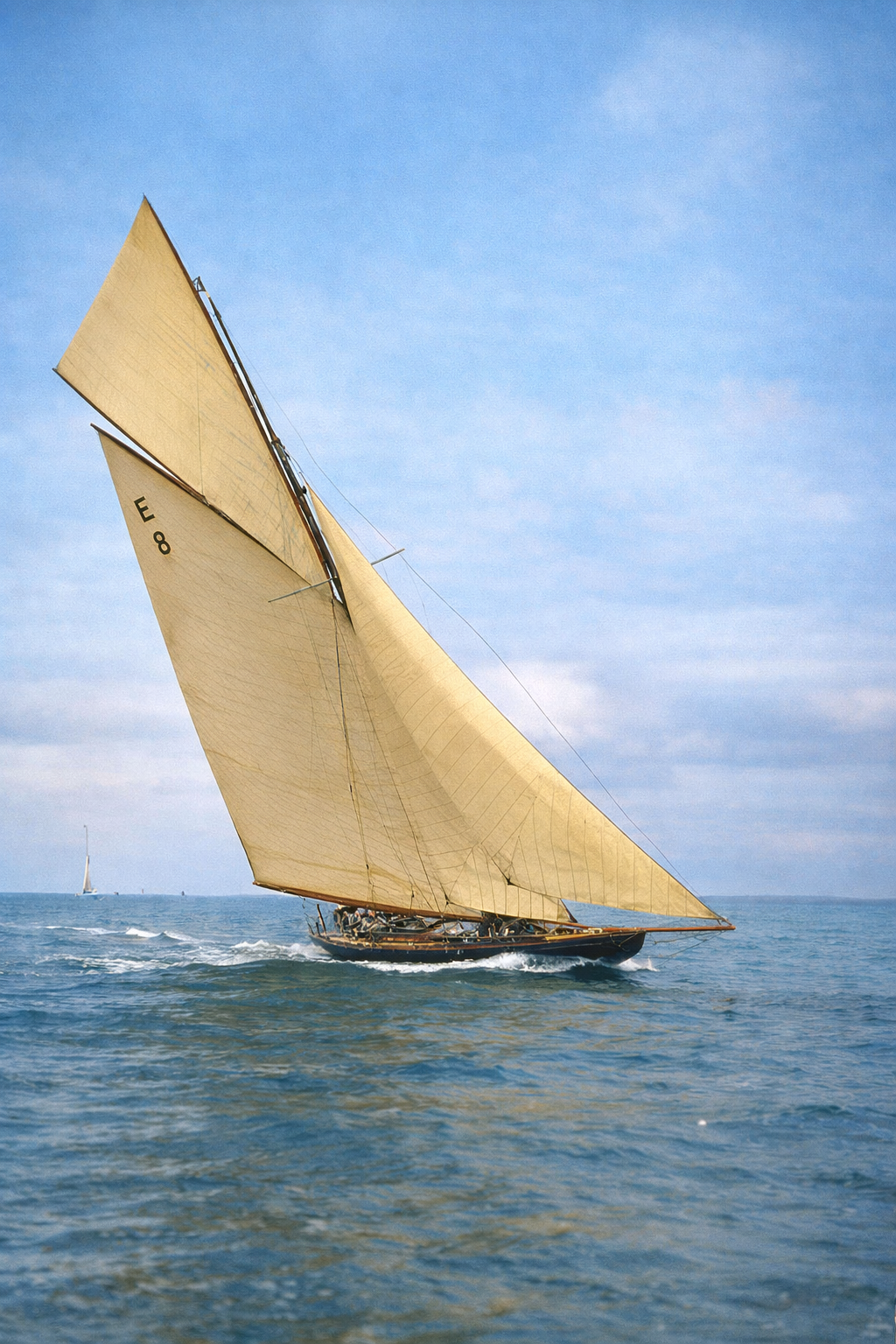
Rollo
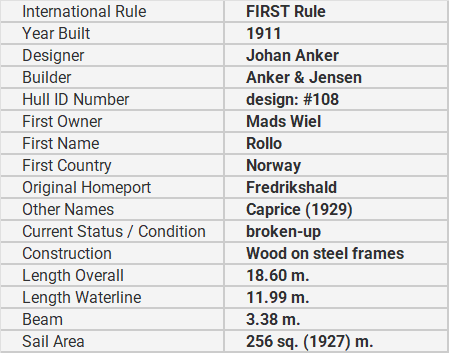
Design & Construction
Rollo was designed in 1911 by Johan Anker and built the same year by Anker & Jensen at Fredrikshald (Halden), Norway. Constructed of wood on steel frames, she was built to the International First Rule and represented one of the most powerful and advanced Twelve Metre designs of her era. With a comparatively large sail plan and a full, powerful hull form, Rollo embodied Anker’s philosophy of seaworthiness combined with speed.
Ownership & Naming
Rollo was commissioned and initially owned by a Norwegian syndicate headed by Mads Wiel, and sailed from the outset under the Norwegian flag with her home port at Fredrikshald. Johan Anker himself frequently sailed the yacht, a rare circumstance that would prove decisive in her early success.
Cowes Week & International Recognition (1911)
In 1911, Rollo sailed under her own power and crew across the North Sea to compete at Cowes Week, where she delivered one of the most dominant Twelve Metre performances of the period. From seven starts, she recorded four first places and one third, winning the class convincingly.
Writing in Yachting Monthly (September 1911), contemporaries described Rollo as the outstanding yacht of the regatta, noting her black hull, red-jerseyed Norwegian crew, and the inability of established rivals such as Alachie, Javotte, and Ierme to stay with her. At the regatta dinner, the President of the Royal Yacht Squadron publicly praised the achievement, emphasizing that the Norwegians had built, sailed, and raced their own yacht to victory — “that is what I call sport.”
Subsequent Ownership & Renaming
Following her celebrated debut, Rollo passed through several Norwegian owners. Between 1912 and 1920, she was owned by P. H. Mathiessen of Christiania (Oslo), followed by Harald Pettersen (1921–1922) and Ingmar Dobloug (1923–1927). In 1927, under Dobloug’s ownership, she was renamed Caprice.
From 1927 to 1932, she was owned by Wilhelm Mustad of Oslo and remained listed in Lloyd’s Register as “formerly International Rating Class 12 Metres.”
Later Career
During the 1930s and 1940s, Rollo (still known as Caprice) passed through additional ownership, including Ladvig Lorentzen, Magnus Konow, and later Sigurd Skaugen. She competed sporadically, including an appearance at the Royal Norwegian Yacht Club Jubilee Regatta at Hanko, where she recorded a third-place finish.
As newer designs rendered early First Rule Twelves obsolete, Rollo gradually faded from competitive sailing.
Final Years
Rollo disappeared from Lloyd’s Register in the early 1950s and is generally believed to have been broken up, although no precise date or location of her dismantling has been recorded.
Historical Significance
Rollo is remembered as one of the great breakthrough Twelve Metres, establishing Johan Anker’s international reputation and demonstrating that Scandinavian designers and crews could challenge — and defeat — the best British yachts on their own waters. Her 1911 Cowes Week performance remains one of the most celebrated debuts in Twelve Metre history and a defining moment in early international yacht racing.