
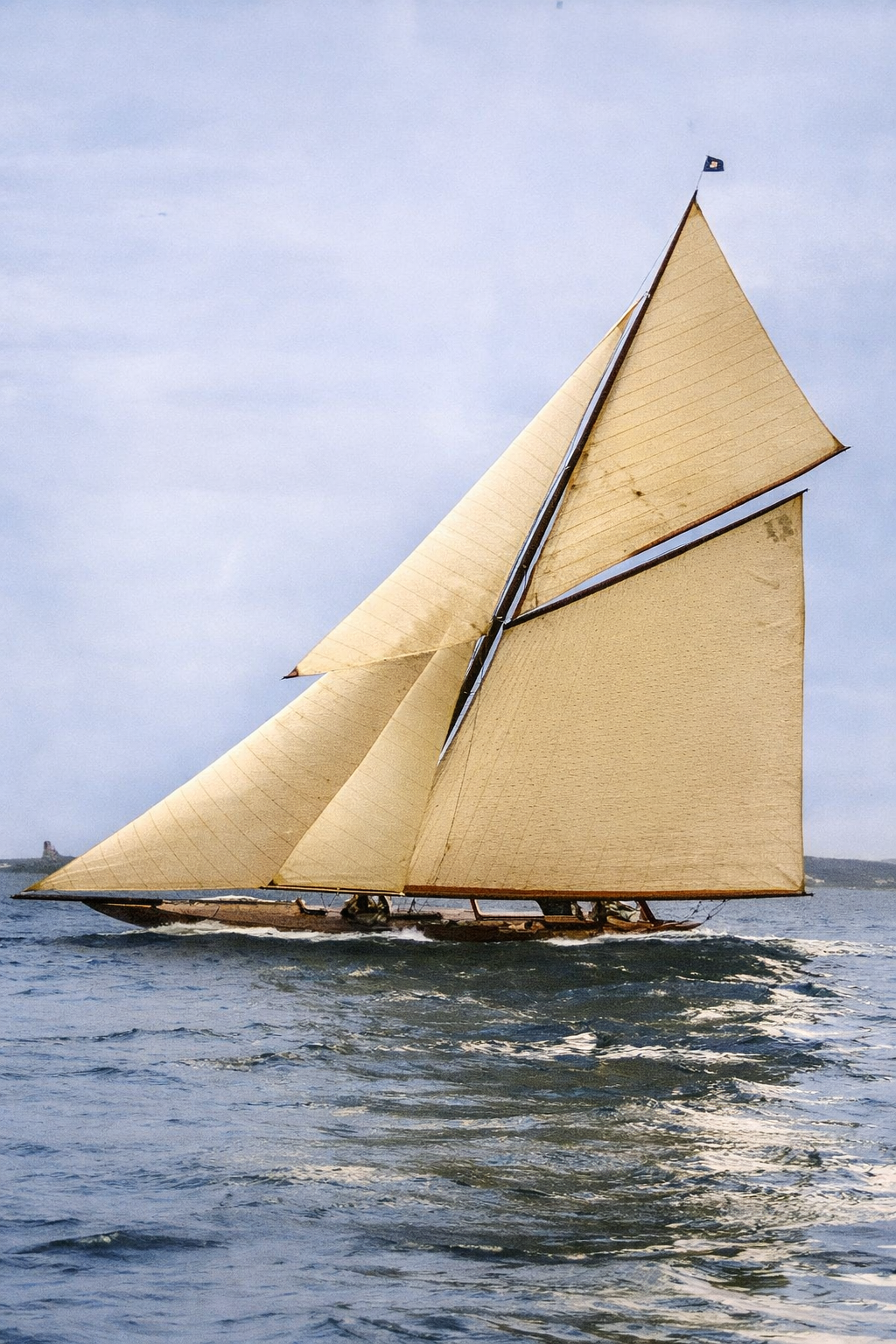
Skeaf IV
Design and Construction
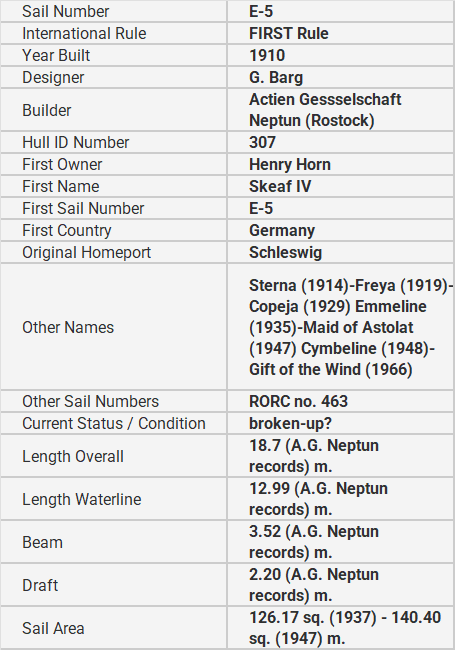
Skeaf IV was an International 12 Metre yacht built to the International First Rule, entering service in the 1910–1912 period. She formed part of the influential Skeaf series commissioned by B. Consul Henry Horn, one of the most significant private owners in the early history of the 12 Metre class. While the specific designer and builder have not been conclusively documented in surviving public records, Skeaf IV clearly belongs to the final generation of First Rule yachts built immediately prior to the First World War.
Original Ownership and Early Years
From launch, Skeaf IV was owned by B. Consul Henry Horn, with her home port listed as Schleswig, Germany. Horn was a prominent German industrialist and major wood importer, and the owner of five Twelve Metres, all bearing the name Skeaf. His yachts were regular competitors in Northern European regattas and represented an ongoing process of development through successive designs. Skeaf IV remained under Horn’s ownership through the pre-war years.
Post-War Career and Early Renamings
Following the First World War, Skeaf IV entered a long and complex second career under a succession of owners and names in Northern Europe. During this period, she sailed under the names Sterna, owned by Mme. Van de Poll with her home port in Haarlem, Netherlands, and later Freya, owned by C. P. J. Stam Jr., with home ports in Amsterdam and later Koog aan de Zaan.
Subsequently, the yacht was renamed Copeja under the ownership of Jan Jacob van Rietschoten Jr., with her home port listed as Rotterdam, Netherlands. Van Rietschoten was the father of Cornelius van Rietschoten, later winner of the 1977–78 Whitbread Round the World Race aboard Flyer.
British Ownership and Modifications
During the interwar period, Skeaf IV moved to Great Britain and continued her career under several new names and owners. As Emmeline, she was owned by Flying Officer G. R. Canavan, with home ports listed as Southampton and Portsmouth. Prior to 1935, the yacht’s rig was altered to a Bermudan cutter, marking a significant departure from her original First Rule racing configuration.
Later British owners included Mrs. Elaine Hamer, under the name Maid of Astolat, and Dr. J. P. Leckie, who renamed the yacht Cymbeline from 1948, with her home port remaining Southampton.
Later Years and Technical Changes
Under post-war British ownership, Skeaf IV continued in active use as a cruiser-racer rather than a pure racing yacht. She received an engine installation in 1957, was re-powered in 1964, and carried an RORC rating of 49.26 in 1951. Ownership during this period included the heirs of Dr. Leckie, Raymond Richards, Colin A. G. Campbell of Hamble, Belsize Boat Yard Ltd. of Southampton, and later Eric J. I. Ward and Michael C. G. Ward of Littlehampton.
Later History and Disappearance
After the mid-1960s, Skeaf IV was sold to Germany and later appears under the name Gift of the Wind, associated with Tana Kaleya and Tana Kaleya Coty & Co., Salzburg. Beyond this point, ownership records become fragmentary. At an unknown date, the yacht disappeared from Lloyd’s Register, and no formal documentation of her final disposition has been identified.
Historical Significance
Skeaf IV is historically significant as a First Rule International 12 Metre with an exceptionally long service life, spanning more than six decades and multiple countries. Her extensive sequence of renamings and adaptations illustrates the evolution of early racing yachts into post-war cruising and offshore vessels, making her one of the most enduring and well-travelled yachts of the Skeaf series.