
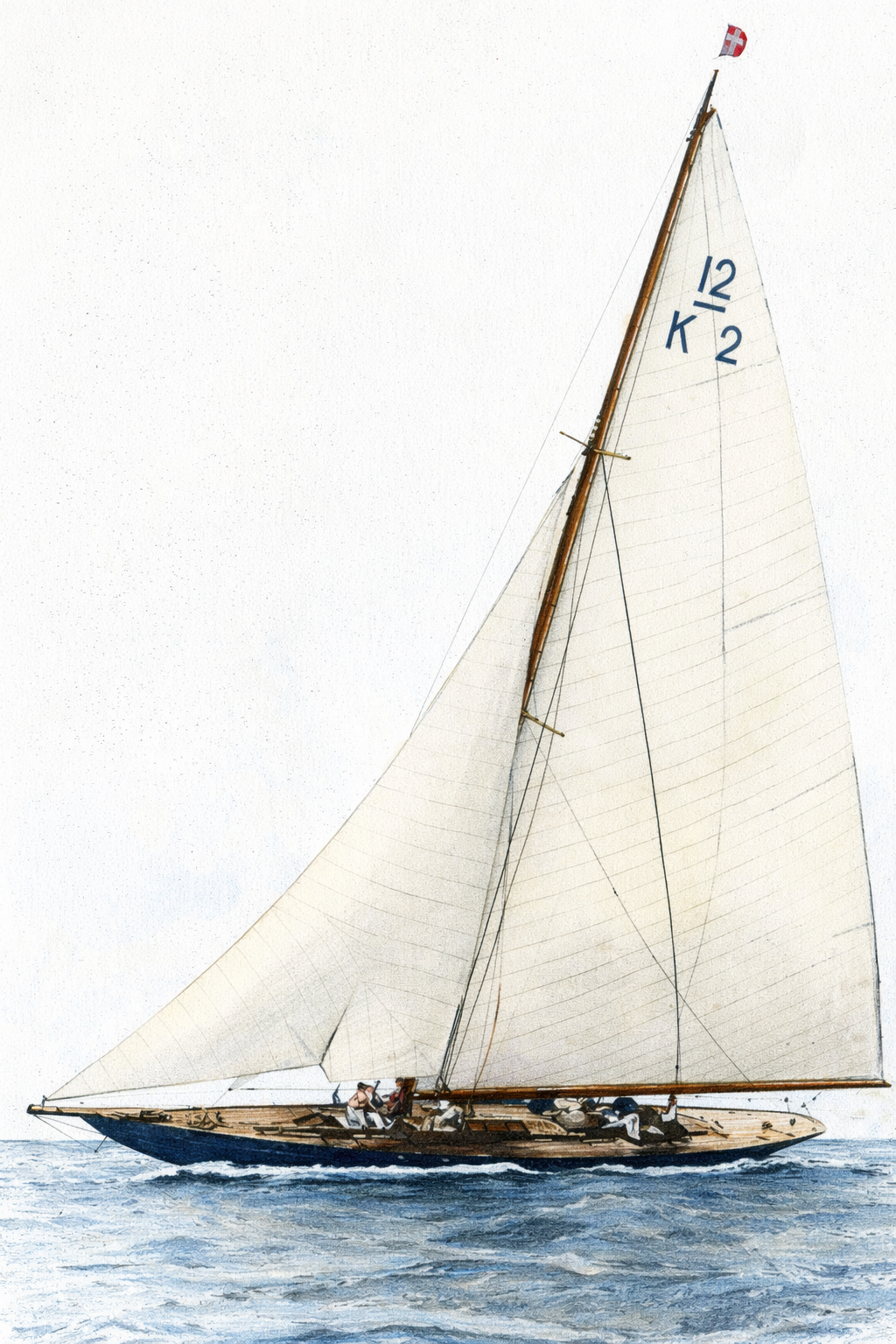
Tatjana 12 K 2
Design & Construction
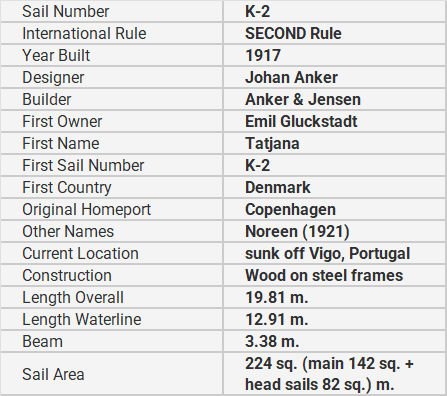
Tatjana was built in 1917 by the celebrated Scandinavian partnership Anker & Jensen, to a design by Johan Anker, one of the most influential yacht designers of the early 20th century. She was originally constructed under the “S” Scandinavian Rule, an interim rating rule used briefly prior to the revision of the International Rule, and was later converted to comply with the International Second Rule Twelve Metre formula, under which she raced for much of her competitive life.
Construction Characteristics
Contemporary descriptions, including a detailed assessment published in Yachting Monthly, describe Tatjana as a composite-built yacht showing clear development beyond Anker’s earlier designs. Her kauri pine decks were noted as particularly well laid, with finely finished hull planking. All aspects of the yacht prioritized speed: interior fittings were extremely light, though still considered comfortable by period standards. The long mast was raked, stepped without wedging at the deck, with thrust taken entirely at the heel. She carried three sets of spreaders, one notably low by contemporary practice, and comparatively light rigging—made possible by the absence of gaff-rig thrust after conversion to Bermudan sail plans.
Early Ownership & Scandinavian Period (1917–1924)
Tatjana’s first owner was Nyqvist, followed by Emil Glückstadt, a highly influential Danish banker and prominent yachtsman, also known for owning the famous Juniar and Elge as well as several large motor yachts. During this period, Tatjana was based in Copenhagen, Denmark, and in 1919 she was altered to a Bermudan cutter, making her one of the early adopters of this rig among large Scandinavian racing yachts.
In 1921, Tatjana undertook a remarkable passage from Denmark to England, carrying a spinnaker continuously for three days and two nights. That same season, she suffered a dramatic dismasting during a squall, yet continued racing as a Twelve Metre between 1921 and 1924.
British Racing Career – Noreen (1924–1928)
Under ownership by Frederick Last, Tatjana was renamed Noreen and registered with sail number K-2, with London as her home port. Her most successful racing year was 1923, when she competed at the Burnham-on-Crouch regattas, defeating Alachie and racing directly against Vanity. That season, she achieved 11 firsts, 11 seconds, and 1 third from 30 starts, an exceptional record.
In 1924, she reportedly won 25 flags, although this success was tempered by three separate dismastings in the same season. Following this intense campaign, she was advertised for sale through Camper & Nicholsons.
Experimental Years – Crankshaw Ownership (1929–1939)
Between 1929 and 1939, Tatjana (still sailing as Noreen) was owned by M. Crankshaw, a mechanical engineer and experienced yachtsman with a strong interest in experimental rig and hull development. During this period, the yacht underwent numerous significant modifications:
1929: Converted to a Bermudan yawl, with a sail area of approximately 225 m²; interior rearranged with the owner’s cabin forward of the saloon.
1932: Re-rigged as a Bermudan cutter with staysail, jib, and jib topsail, following design input from C. E. Nicholson; boom shortened; sail area reduced to 156 m².
1933: Major structural modification with the mast moved approximately 10 feet aft, nearly amidships; mast constructed from two scarphed sections; keel deepened by ~30 cm.
Although her results as a pure Twelve Metre during this phase were modest, Tatjana achieved notable success in large handicap races. One of her most celebrated performances came in the 1938 Weymouth Royal Thames YC race, where she finished 1 minute 19 seconds ahead of the winning Twelve Evaine despite starting 15 minutes later. In the 1938 season, she won 9 flags in 10 starts.
Final Years & Loss (1940–1948)
In 1946, while owned by G. L. Welstead of Poole, an auxiliary engine was installed. She was subsequently owned by Harold F. Smith of London. During this period, Tatjana was listed in Lloyd’s Register as an auxiliary Bermudan cutter, though notably without an owner’s name recorded.
By 1948, the yacht was in poor structural condition, with leaking hull and deck and unreliable rigging. After relocating to Barcelona, Spain, Tatjana (still known as Noreen) was caught in a severe storm on 30 June 1948. While being towed by a French tanker toward Vigo, she sank, and was subsequently struck from Lloyd’s Register, marking the end of one of the most extensively modified and experimentally campaigned Twelve Metres of the early era.
Historical Significance
Tatjana occupies a unique position in Twelve Metre history as a transitional yacht, bridging Scandinavian Rule practice and International Rule development. Her long competitive life, repeated rig transformations, and experimental mast and keel alterations make her a rare case study in early 20th-century big-boat innovation. She represents the golden experimental era of the Metre Classes, when owners and designers were still discovering the practical limits of Bermudan rigs, hull balance, and rating optimization.