
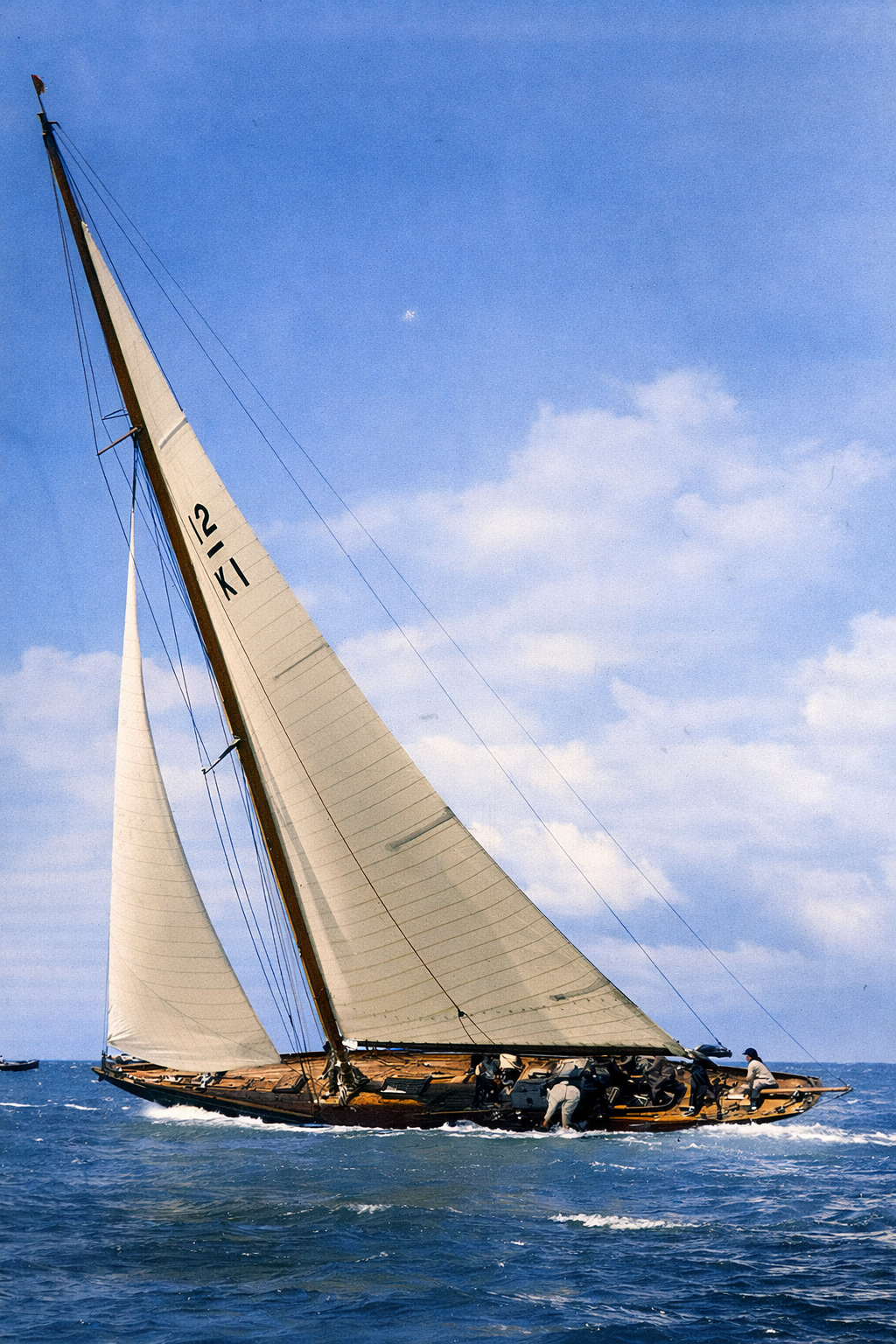
Vanity 12 K 1
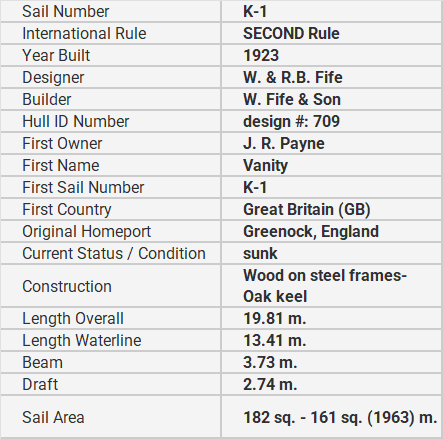
Design & Class
The original Vanity (K-1) was an International Second Rule Twelve Metre, designed by William Fife III and completed in 1923. She pre-dated and later inspired Vanity V, commissioned by the same owner more than a decade later.
Ownership & Early Career (1923–1932)
From launch through the height of her racing career, Vanity was owned by J.R. Payne, universally known as “Fiddler” Payne, with Greenock, Scotland recorded as her home port. Payne—regarded as one of the finest helmsmen of his era across 15-Metres, 12-Metres, and large handicap yachts—often lived aboard Vanity, cruising and racing extensively around the British coast and across the Channel.
During the 1920s, Vanity was widely considered the most successful Twelve Metre of the decade. She competed in nearly all major regattas and coastal races, including events at Burnham, Cowes, Harwich, and Channel crossings to Le Havre. In 1923, she was the scratch yacht at Burnham Week; in 1925, she recorded three first places racing against Noresca, Moyanna II, Clymene, and Doris. Contemporary accounts frequently noted that “the old Vanity still could hold her own with the newer boats under conditions that suited her.”
Originally rigged as a gaff cutter, Vanity was converted to a Bermudan cutter in 1929. Beken of Cowes documented her racing with both rigs, providing rare visual evidence of her evolution.
Continued Racing & Handicap Career (1933–1937)
As Twelve Metre fleet racing declined in Britain, Vanity transitioned into handicap and cruiser-class racing while remaining competitive. Under various owners, she:
Won at Cowes Week (1933) in the under-35-ton handicap class
Entered experimental handicap events (e.g., Ramsgate, 1933)
Competed in renewed Twelve Metre events in 1932–1933, finishing 2 firsts and 1 third in seven starts
By 1936, she had been further modified to a Bermudan sloop and continued to race with success.
Later Ownership, Modifications & Trials Role (1938–1962)
Between the late 1930s and early 1960s, Vanity passed through a long succession of owners, including:
David Anderson
W. Stannard
Lt. Col. D.A.G. Dallas
Mrs. Katherine MacDonnell (Guernsey)
Lt. Cmdr. P.S. Boyle (Greenock)
An auxiliary engine was installed in 1951, with further re-powering in 1955 (removed again in 1958). During the 1950s, Vanity achieved RORC ratings including 49.48 (1951) and 47.73 (1955).
Notably, during this period she was modernized under the direction of David Cheverton and used as a trial horse in support of the British America’s Cup challenger Sceptre, reflecting her enduring value as a development platform long after her prime racing years.
Conversion & Final Years (1963–1992)
In 1963, Vanity was again re-powered and converted to an auxiliary yawl, receiving an RORC rating of 42.37. Later owners included Martin Sharp and G. Hommel, with home ports variously listed as Cowes, Nyon, Geneva, and later Hamburg. Another re-powering occurred in 1973.
Despite her age, Vanity remained afloat and in use for nearly seven decades, an exceptional lifespan for a Second Rule Twelve Metre.
Loss
Vanity ultimately sank during Hurricane Hugo while in the Caribbean, bringing to an end the life of one of the most durable and influential early Twelve Metres.
Historical Significance
The original Vanity (K-1) stands apart from Vanity V as:
The most successful Twelve Metre of the 1920s
A benchmark Second Rule Fife design
A yacht with an extraordinarily long and varied career, spanning elite fleet racing, handicap competition, development trials, and cruising
The direct precursor that led J. R. Payne to commission Vanity V (1936)
Her career encapsulates the transition of Twelve Metres from pure racing machines to adaptable, long-lived yachts—an evolution few examples illustrate as completely as Vanity.