

Victoria (unbuilt)
Design & Rule Context
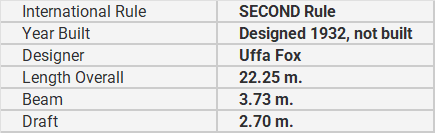
VICTORIA was a Second-Rule International Twelve Metre design prepared in 1932 by Uffa Fox. The project was conceived during the final and most refined phase of the International Second Rule, immediately prior to the introduction of the Third Rule in 1933.
This period saw designers pushing the limits of hull form and sail efficiency within the increasingly constrained Second-Rule framework, and Victoria belongs squarely in that transitional moment.
Design Characteristics
Although never built, Victoria’s principal dimensions are recorded:
Length overall: 22.25 m
Beam: 3.73 m
Draft: 2.70 m
These proportions suggest a slender, performance-oriented hull, consistent with Fox’s design philosophy at the time, emphasizing light displacement, powerful sail plans, and responsiveness—particularly in moderate to fresh conditions.
Designer’s Intent
By 1932, Uffa Fox had already established himself as one of the most innovative and outspoken designers in British yacht racing. Victoria appears to have been intended as a competitive Second-Rule Twelve, possibly aimed at domestic British competition rather than an America’s Cup campaign.
There is no evidence that the design progressed beyond the design stage, and no sail number was applied for or issued.
Project Outcome
Victoria was never built, and no construction was commenced. As with several late Second-Rule designs, the project was likely overtaken by:
The impending rule change to the Third Rule
The high cost of Twelve-Metre construction
Shifting owner interest toward newer design philosophies
No model, tank-test record, or surviving plans are currently known to be publicly archived.
Historical Significance
Although unbuilt, Victoria is of interest because she represents:
A late Second-Rule design by Uffa Fox
A conceptual bridge between mature Second-Rule yachts and the radically different Third-Rule Twelves
One of several serious Twelve-Metre designs abandoned during the rule transition of the early 1930s