
Vineta 12 E 10
(ex Vanita, Bonita, Figaro II, Figaro) – 12 Metre Class
Design & Construction
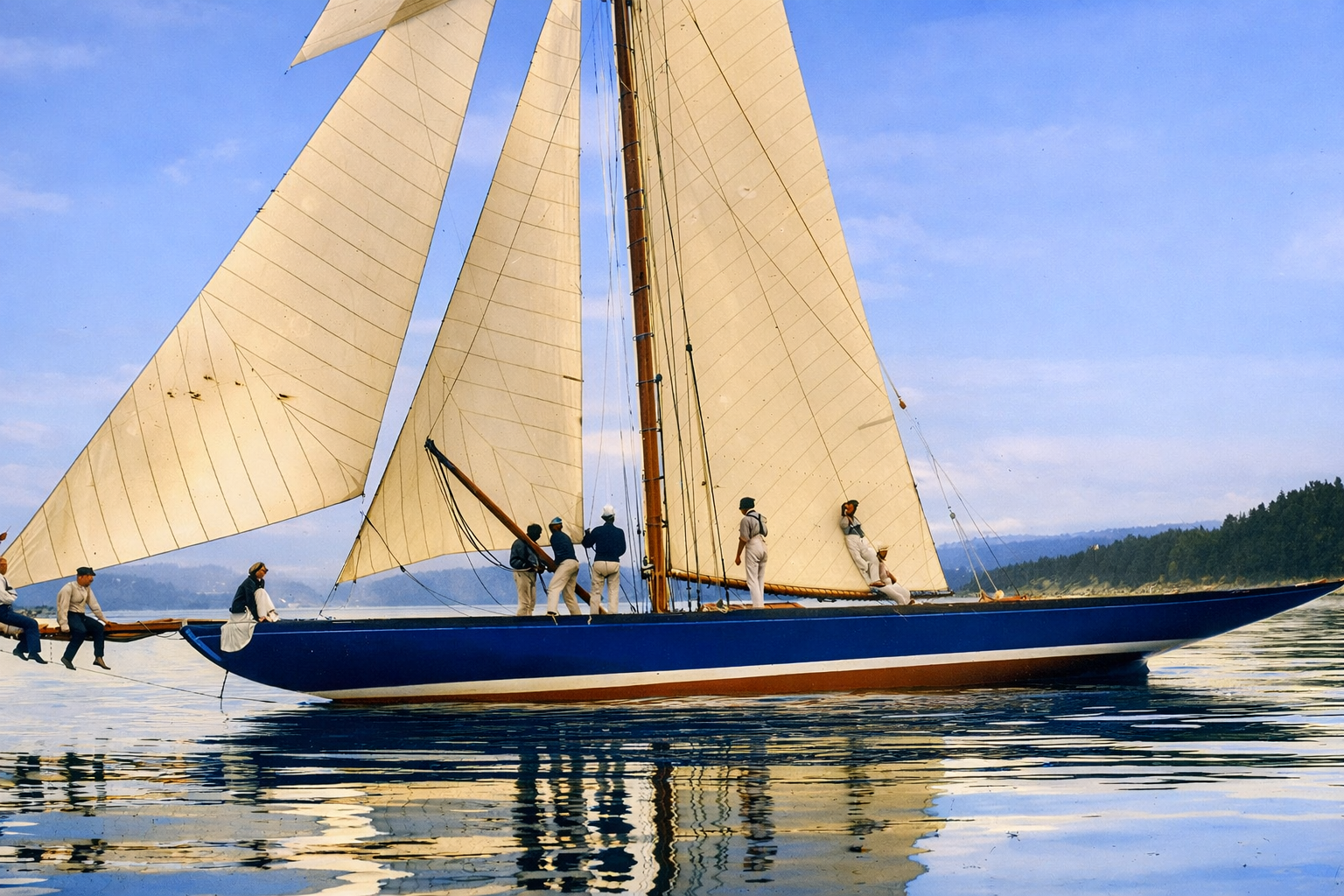
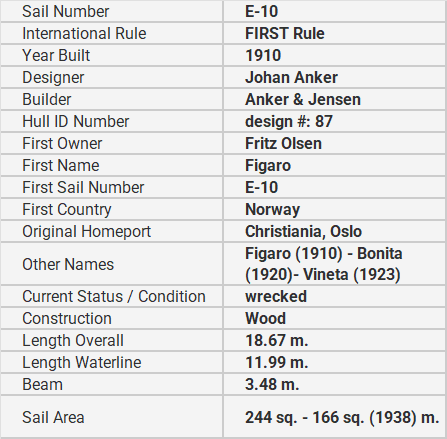
Vineta was built in 1910 to the International First Rule as a 12 Metre Class yacht, designed by Johan Anker and constructed at Anker & Jensen in Oslo. She was Anker’s refined interpretation of the early International Rule Twelve, combining a long, narrow hull with pronounced overhangs and exceptional balance. The yacht was originally built as Figaro, the second Figaro commissioned by her owner, following an earlier Colin Archer design.
Early Ownership and Norwegian Career (1910–1918)
From 1910 to 1918, the yacht sailed under the name Figaro, owned by Fritz Olsen of Christiania (Oslo). She was actively raced and recognized as a competitive First Rule Twelve during a formative period of International Rule development.
Transition to Figaro II and Bonita (1919–1922)
Between 1919 and 1922, ownership passed to Fritz and Rudolf Olsen, after which Rudolf Olsen became sole owner and renamed the yacht Figaro II. In 1922, she was sold to O. Berresen, who renamed her Bonita. Under this name, the yacht continued racing in Scandinavian waters, maintaining her reputation as a fast and well-balanced Twelve.
Renamed VINETA and Scandinavian Racing (1923–1935)
In 1923, the yacht was acquired by S. Finne Thiis, French Consul in Oslo, and renamed Vineta. Under this name she competed internationally, including a notable appearance at the July 1933 Jubilee Regatta in Hanko, Finland, where she won first place in the third race. During this period, Vineta retained her classic First Rule characteristics while remaining competitive against newer designs.
French Ownership and Peak Racing Years (1935–1946)
In 1935, Vineta was purchased by Franck Guillet of La Trinité-sur-Mer, owner of the 12 Metre Le Cid. During this French period, Vineta entered and won several regattas and was also used as a support and mother ship for Guillet’s other racing yachts.
In 1938, her rig was converted from gaff to Bermudan, aligning her with contemporary performance trends. From 1939 to 1945, she was laid up ashore at the Constantini yard, dismasted during the war years. She returned to sailing in 1946.
Post-war Modifications and Decline (1947–1955)
Sold in 1947 to G. de Surmont of Paimpol, Vineta received a new engine in 1950, and her mast was shortened. Racing activity declined, and she was eventually laid up.
Subsequent owners Mr. and Mrs. Thomas dismantled the yacht: the mast was broken up and the lead keel removed and sold, marking the end of her active sailing life. In 1955, Vineta disappeared from Lloyd’s Register.
As a Surviving Hull (1955–1999)
Although often described as “wrecked,” Vineta was not lost at sea. She survived as a dismantled hull laid up at Coët-Castel (France), where limited preservation work—caulking and linseed oil treatment—was carried out to prevent total loss. After more than two decades, she was moved to Lézardieux and later Montauban.
In 1999, a group of Norwegian enthusiasts sought to purchase and restore the yacht to her original configuration, but the owner refused to sell.
Final Ownership and Documentation (Since 1999)
Since 1999, Vineta has been owned by Michel Durand, remaining in substantially the same dismantled condition. She was remeasured, and a new set of plans was commissioned from François Chevalier, preserving her technical record even as restoration did not proceed.
Historical Significance
Vineta represents a rare surviving example of an International First Rule 12 Metre hull designed by Johan Anker. Her long competitive life under four names—Figaro, Figaro II, Bonita, and Vineta—illustrates the adaptability of early Twelves across multiple eras, owners, and rig configurations. While no longer sailing, her documented survival ashore places her among the most historically traceable First Rule Twelves of the class.