
Waiandance
12 US 1
Design & Construction
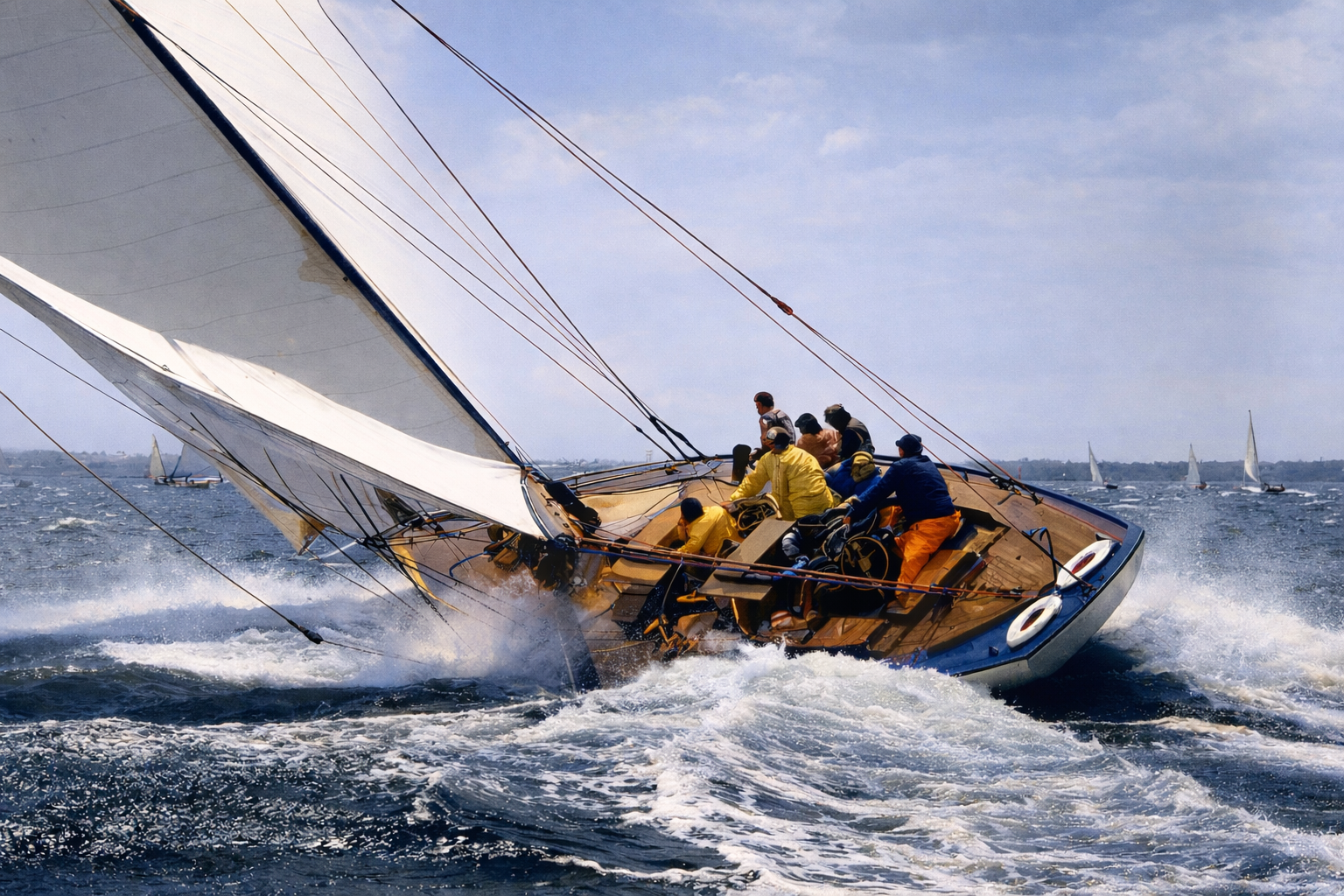
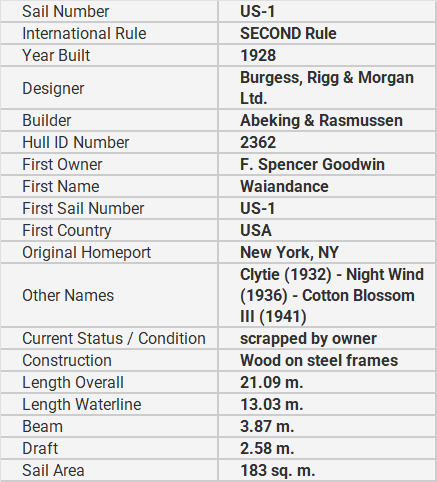
Waiandance (US-1) was built in 1928 to the International Second Rule as one of the six Twelve Metres commissioned by the New York Yacht Club for internal comparison racing. The yachts were designed by William Starling Burgess and built by Abeking & Rasmussen in Germany.
All six hulls were identical in form, while deck layouts, interior arrangements, and rigs varied, allowing meaningful performance comparisons within the class.
Construction was composite, with every second frame made of galvanized steel, including the floor plates, and Honduras mahogany planking, a favored material of the period. The yachts were built in serial production in approximately five months and shipped together to Halifax, Nova Scotia, where they were rigged and then sailed to the United States, avoiding U.S. import duties.
Waiandance was completed in May 1928.
She was one of the group comprising Waiandance (US-1), Isolde (US-2), Tycoon (US-3), Iris (US-4), Anitra (US-5), and Onawa (US-6). Of these, only Anitra and Onawa survive.
Original Ownership and Racing Success (1928–1930)
From 1928 to 1930, the yacht was owned by F. Spencer Goodwin, sailing as Waiandance, with home port New London, Connecticut.
The name Waiandance (also spelled Wyandanch) refers to a Montauk sachem who participated in the Pequot War, securing trading rights in the Saybrook, Connecticut region.
Clytie – Championship Years (1931–1935)
Between 1931 and 1935, the yacht was owned by Henry B. Plant and renamed Clytie.
During this period she achieved her greatest competitive success, winning:
12 Metre Class Long Island Sound Championship (1931)
12 Metre Class at Larchmont Race Week (1931)
These victories established her as one of the most successful of the Burgess Abeking & Rasmussen Twelves.
Night Wind (1936–1940)
From 1936 to 1940, ownership passed to W. Roy Manny, who renamed the yacht Night Wind, with home port Larchmont, New York. She continued racing and cruising during this period, maintaining her reputation as a powerful Second Rule Twelve.
Cotton Blossom III and Conversion (1941–1951)
Between 1941 and 1951, the yacht was owned by Walter B. Wheeler, Jr., renamed Cotton Blossom III, and based in Stamford and Noroton, Connecticut.
In 1942, her rig was altered to a yawl, reflecting changing cruising preferences, and in 1946 an engine was installed, further adapting her for post-war auxiliary use.
Final Years and Destruction (1952)
In 1952, while hauled out at Schofield Shipyard, Stamford, Connecticut, the yacht was damaged by fire and subsequently scrapped by her owner.
Significantly, parts of Waiandance were later reused in the reconstruction of Onawa (US-6) in 2001, giving her a tangible legacy within the surviving Twelve Metre fleet.
Historical Significance
Waiandance stands as a textbook example of the New York Yacht Club’s 1928 comparison program, a rare instance of near-identical Twelve Metres built expressly to evaluate design, rig, and deck-layout variations. Her championship wins as Clytie, combined with her well-documented construction and final contribution to the restoration of Onawa, secure her place among the most historically important — though no longer extant — Twelve Metres of the class.