
White Heather
Design and Historical Context
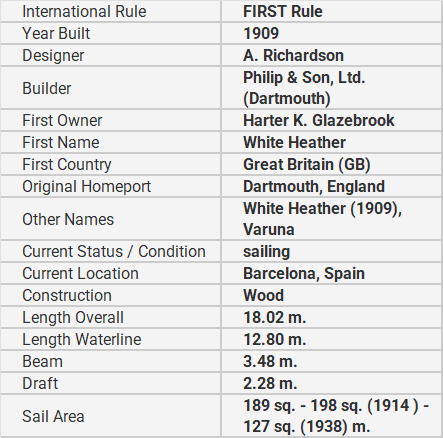
Launched in 1909, WHITE HEATHER was conceived at a transformative moment in international yacht racing. Following the 1906 London Conference, the International Rule was introduced to unify the fragmented national rating systems then in use. The resulting “metre classes” (4m, 6m, 8m, 12m, etc.) were defined by a measurement formula rather than actual hull length, giving rise to a new era of internationally competitive yachts.
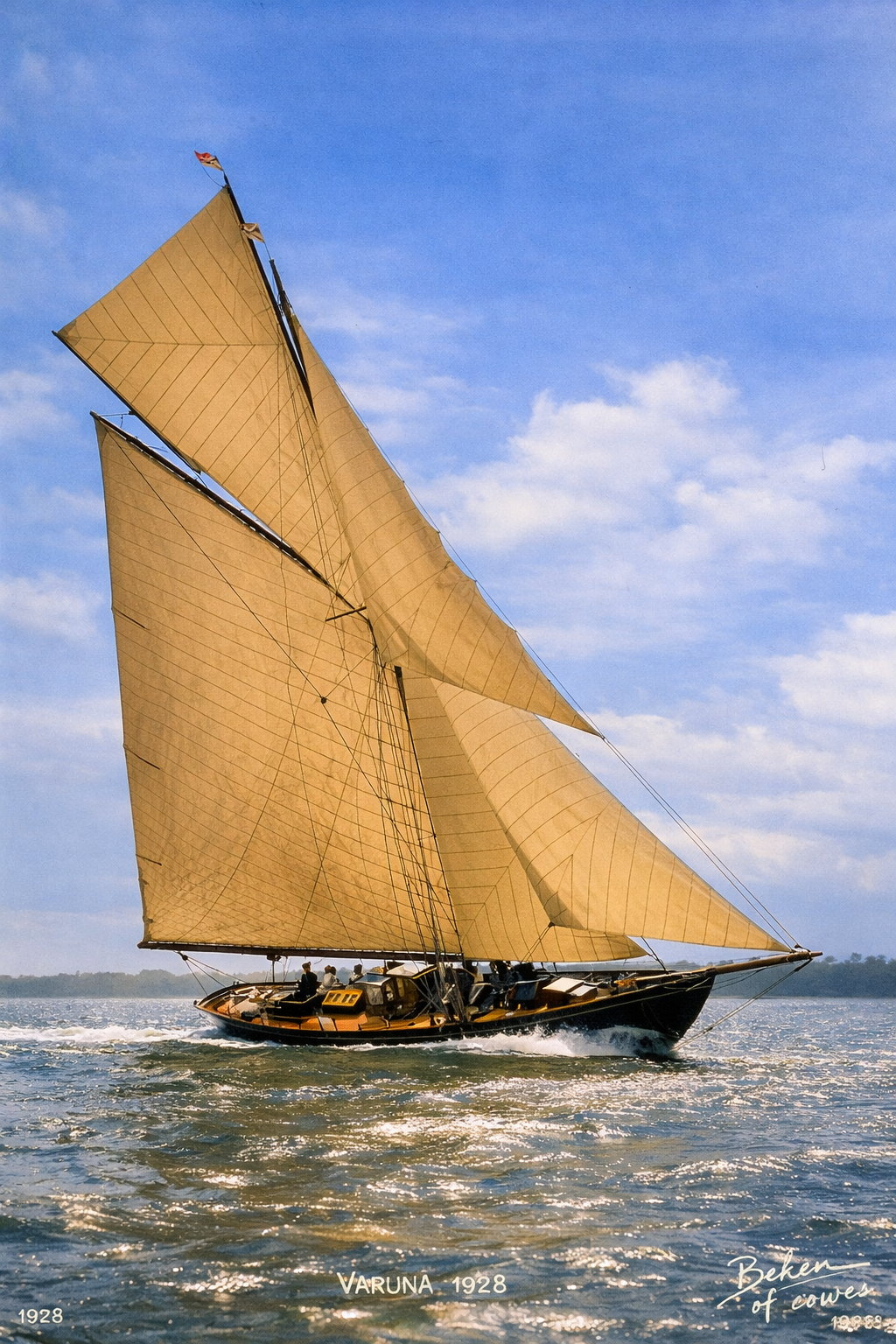
Designed by A. Richardson, WHITE HEATHER was rated under the International First Rule as a 12 Metre, but from the outset she differed from many of her contemporaries. Rather than being conceived as an outright racing yacht, she was designed as a gentleman’s Twelve, capable of extended cruising as well as competitive sailing. Her relatively generous freeboard, full ends, and prominent doghouse distinguished her from the more extreme racing Twelves of the period.
Contemporary observers frequently remarked on her strong visual resemblance to BRITANNIA, King George V’s famous royal yacht. This likeness—clearly intentional—earned WHITE HEATHER the long-standing nickname “Little Britannia”, particularly in Cowes, where she cruised regularly.
Construction
WHITE HEATHER was built by Philip & Son of Dartmouth, one of Britain’s premier yacht-building firms of the era. She was constructed with oak main frames, rack elm intermediate frames, and extensive use of teak for beams, deck, and hull planking.
A persistent tradition holds that the Burmese teak used in her construction had been imported decades earlier and seasoned in English peat bogs before use. While this story cannot be conclusively verified—Philip & Son’s yard archives were destroyed during wartime—it is consistent with known timber-handling practices of the period and with the exceptional durability of the yacht’s structure.
Early Career
From launch, WHITE HEATHER was registered as an auxiliary 12 Metre, reflecting the International Rule’s requirement that larger yachts provide habitable accommodation. She was never intended to be a pure regatta specialist; instead, she was widely used for cruising, training, and comparative sailing, including extended voyages in the Baltic and along the west coast of Scotland.
In 1914, her sail area was increased from 189.63 m² to 198.50 m², and from that year she appears in Lloyd’s Register as “formerly Int. Rating Class 12 Metres.”
During this period, WHITE HEATHER was often used as a training platform for other Twelve Metres, reflecting both her seaworthiness and her forgiving handling characteristics.
Rig Evolution and Renaming
Originally rigged as a gaff cutter, WHITE HEATHER followed the broader evolution of yacht design during the interwar years. By the late 1920s she had been converted to a Bermudan (Marconi) rig, fitted with an auxiliary engine, and her original tiller steering was replaced by a wheel.
At this point she was renamed VARUNA, after the Vedic deity of the oceans and waters. Despite the name change, she continued to be widely known in Cowes and elsewhere as “Little Britannia.”
Ownership History
1909–1928 – Harter Kirkland Glazebrook (Liverpool)
Name: White Heather
Home Port: Dartmouth, UK1928–1932 – Major William Lidswell Towers-Clark
Names: Varuna II, later Varuna
Engine installed; wheel steering adopted1933–1934 – Arthur Henry Ashcroft
1935–1946 – Robert Charles Vernon
Extensive cruising on the west coast of Scotland
New mast fitted in 1936 due to torsional issues
Laid up on the Clyde during WWII; stored equipment destroyed by incendiary bombing1947–1953 – Major M.S.B. Vernon
RORC Rating: 41.571954–1966 – Col. John S. Ward & Col. Ferris B. St. George
Shared ownership with Major Vernon
Re-powered in 19581967–1977 – Mr. & Mrs. G. Earle
RORC Rating: 37.06
Re-powered in 19771978–1983 – Miss P.G. Richardson Hazard
1983–1999 – Neptun Reisen Co. Ltd.
Operated in charter service
Entered long-term decline following owner’s bankruptcy
Abandoned at Cantieri di Imperia, ItalySince 1999 – Dr. Luigi Donna
Restoration and Present Day
After years of neglect in the Caribbean and Mediterranean, WHITE HEATHER—by then long known as VARUNA—was rescued in 1999 and underwent a comprehensive restoration at Cantieri di Imperia, under the direction of Mario Quaranta.
The restoration, completed between 1999 and 2002, respected her historic fabric while ensuring full structural and operational integrity. She was relaunched on 25 May 2002.
Subsequent refinements include:
2003: Rigging modified to suit a revised sail plan
2007: Original mast lengthened by Pasqui, following a new sail plan designed by Jacques Fauroux
Significance
Under her original name WHITE HEATHER, this yacht represents a distinct strand of 12-Metre history:
One of the earliest surviving International First Rule Twelves
A documented BRITANNIA-inspired auxiliary Twelve
A yacht designed for offshore cruising as well as racing
A rare survivor restored with exceptional historical care
More than a century after her launch, WHITE HEATHER remains a living link to the formative years of the International Rule and to the golden age of big-boat yachting.