

Yatset
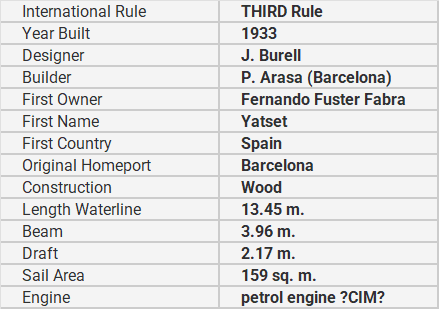
Design & Construction
Yatset was built in 1933 to the International Third Rule, during the formative years of Third Rule Twelve Metre development in Europe. While the designer and builder remain unconfirmed, her construction aligns with contemporary Third Rule characteristics: fuller forward sections, reduced sail area relative to Second Rule yachts, and an emphasis on rating efficiency rather than extreme length.
Spain produced very few Twelve Metres, making Yatset a rare example of a Spanish-based Third Rule Twelve, likely influenced by British and French design trends of the early 1930s.
Ownership
From 1933 to 1936, Yatset was owned by Fernando Fuster-Fabra, with her home port in Barcelona, Spain. The Fuster-Fabra family were prominent engineers and industrialists associated with Fuster-Schneider, a well-known Spanish elevator manufacturing firm later absorbed by Otis. The family were active members of the Real Club Náutico de Barcelona, placing Yatset firmly within Barcelona’s elite pre-war yachting circle.
From 1937 to 1948, ownership is recorded under the Sindicato Único Marítimo, suggesting institutional or syndicate management during the politically turbulent Spanish Civil War and immediate post-war period.
Name & Usage
Although formally registered as Yatset, family accounts indicate that the yacht was privately referred to as “Nancy”, named after the owner’s daughter. This informal naming practice was not uncommon among privately owned Twelves of the period and does not appear to have replaced the official registered name.
Yatset is understood to have been used primarily for cruising and social sailing, rather than sustained international Twelve Metre competition. Spain had limited Twelve Metre racing infrastructure, and most activity would have occurred locally or in informal regattas.
Cultural Associations (Unconfirmed)
Unverified but persistent accounts suggest that Salvador Dalí and other notable cultural figures were guests aboard Yatset during her Barcelona years. While there is no documentary confirmation, the claim is consistent with Dalí’s known presence in Catalonia’s elite social circles and the Fuster-Fabra family’s standing.
These reports should be regarded as anecdotal.
Later Years & Fate
In 1949, Yatset disappeared from Lloyd’s Register, with no subsequent official records. No confirmed documentation exists regarding her final disposition. Her ultimate fate remains unknown.
Significance
Yatset is notable for:
Being one of the very few Twelve Metres based in Spain
Representing the spread of the Third Rule beyond traditional British, French, and Scandinavian centers
Illustrating the social and cruising-oriented use of Twelve Metres outside core racing fleets
Her association—documented and anecdotal—with Barcelona’s pre-war industrial and cultural elite