
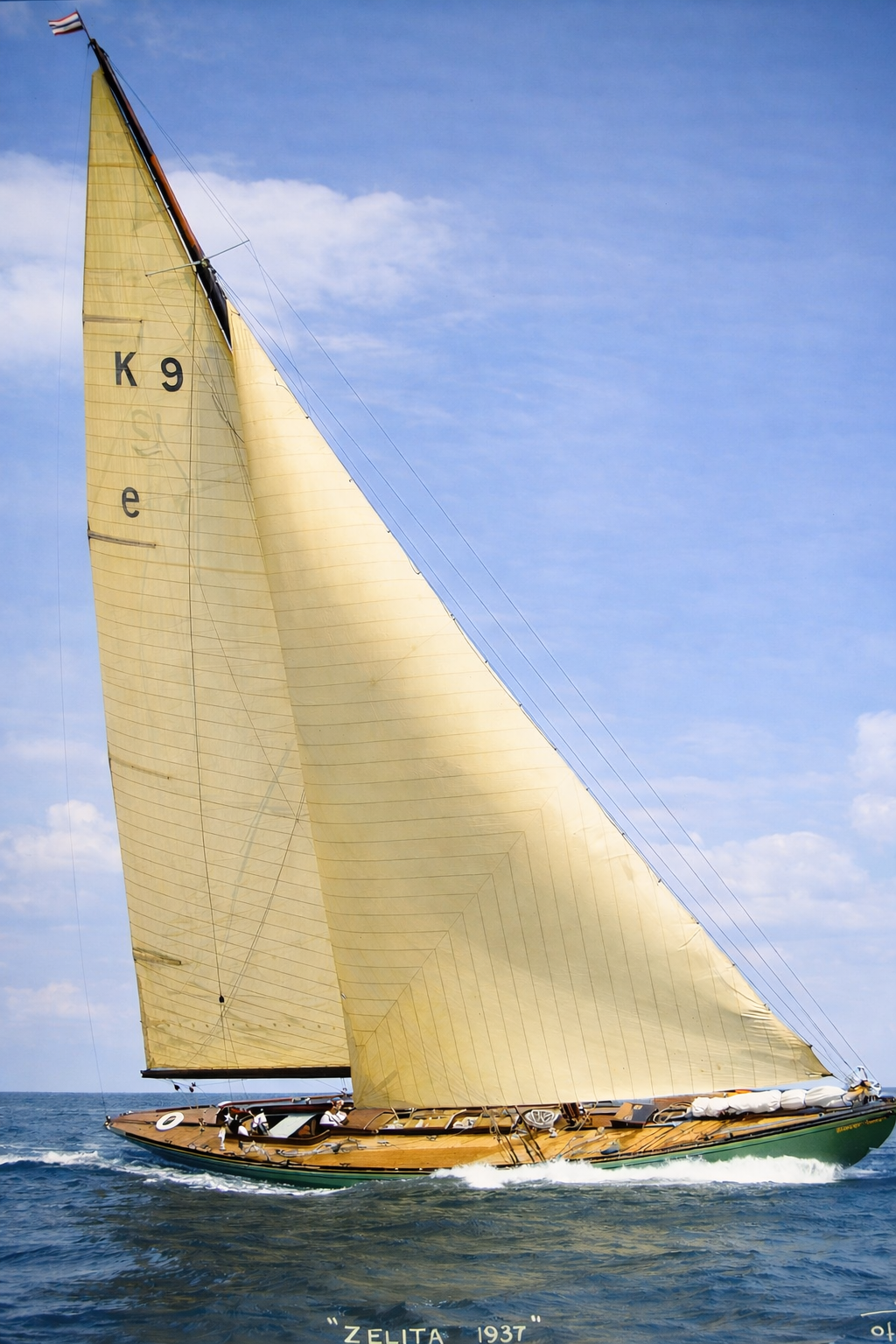
Zelita 12 K 9
Design & Construction
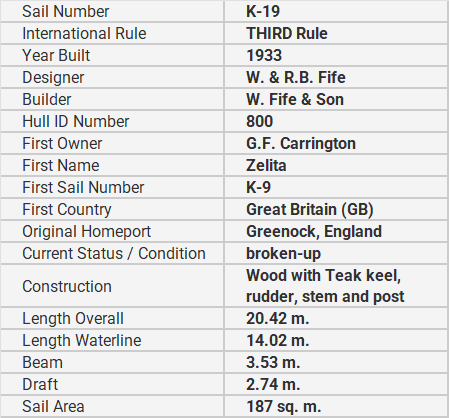
Zelita was built in April 1933 to the International Third Rule by W. Fife & Son, Greenock, Scotland (construction no. 800). She was designed within the Third Rule framework and constructed of wood, with a teak keel, rudder, stem, and sternpost. As built, she was rigged as a Bermudan sloop.
Principal characteristics recorded for Zelita include a sail area of approximately 187 m², consistent with early Third Rule Twelves, and proportions typical of the transitional designs of the early 1930s.
Original Ownership and Early Racing (1933)
Zelita was originally owned by Arthur C. Connell, home port Greenock, Great Britain. Connell was an experienced and prominent Twelve Metre owner, having previously owned Zinita and Zoraida, and later commissioning Westra and Ornsay.
Zelita’s 1933 debut season began on the Clyde, where her early results were disappointing, as she consistently finished behind Veronica and Iyruna. Her season was marred by a dismasting during the final race. Before proceeding south, Zelita underwent structural modifications and stepped a new mast. Although her Cowes Week results remained modest, her performance improved toward the end of the season.
For 1933, Zelita finished fifth overall, with:
29 starts
3 firsts
8 seconds
6 thirds
She was offered for sale at the end of the season.
Carrington Ownership and Continued Racing (1934–1935)
Zelita was purchased by G. F. Carrington, under whose ownership she continued to race but without notable improvement in results.
1934 season:
Fifth overall, 27 starts, with 1 first, 4 seconds, and 3 thirds.1935 season:
Again fifth overall, 24 starts, with 1 first.
Despite consistent participation, Zelita never achieved the front-rank success of contemporary Third Rule leaders.
Later British Ownership and Modifications (1936–1955)
By the late 1930s and post-war period, Zelita passed through additional ownership. Under G. S. Payne, an auxiliary engine was installed in 1949, and she carried a recorded RORC rating of 50.89, reflecting her adaptation from pure racing to auxiliary use.
During this period, racing activity appears limited or undocumented.
Mediterranean Period (1956–1964)
From the mid-1950s onward, Zelita left British waters. She was owned by Lemar S.A., with home ports recorded as Barcelona (Spain) and Panama, and was re-powered prior to 1961.
According to the Real Club Náutico de Barcelona, Zelita was owned during this period by Miguel Hostench, and a photograph published in the 125th Anniversary Year Book of the Club shows Zelita sailing in the Mediterranean, confirming her continued existence and activity at that time.
Final Years and Disappearance (1965–mid-1980s)
After 1965, Zelita disappeared from Lloyd’s Register. Her subsequent history is not officially documented, but multiple consistent reports describe the following sequence:
Zelita was transferred to Porto Vecchio, San Remo (Italy), where she remained moored and largely abandoned, gradually deteriorating. In the early 1980s, she was moved to the new San Remo Marina (Porto Sole) and seized by Italian customs authorities. Anecdotal accounts suggest the seizure may have been linked to a suspected espionage incident involving the Italian Navy, during which the yacht sustained stern damage.
She was subsequently hauled out and left ashore in a condition close to that of a wreck. Zelita was reportedly demolished in the mid-1980s.
These final events remain unofficial but widely repeated in multiple historical accounts.
Significance
Zelita is notable as:
A W. Fife & Son Third Rule Twelve, representing the firm’s engagement with the new rule
An example of a mid-fleet Third Rule yacht, competitive but never dominant
Part of Arthur C. Connell’s sequence of Twelves, bridging his move from earlier disappointments to later success with Westra
A Twelve that enjoyed a long post-racing life in the Mediterranean, unusual among British-built Twelves